2024-2025
Shaping Spaces
The shaping of space can be conceived by way of buildings and other physical means that altered, directed and carved the environment. It also involves far more (and more complex) processes bound to social, economic, religious, natural, conceptual, political and non-human actions and actors, which have shaped spaces in fundamental and transformative ways. With this year’s theme speakers are looking beyond some of the ruts the discipline faces when talking about urbanism, urbanization, proto-urbanism, an so forth, and they think in ample and critical ways about how constituent groups shaped space, and also, how spaces shaped them. In this year, as we think about space, we are also looking beyond the central regions of the peninsula, to the seas and islands that surrounded Etruscan and neighboring spaces.
Keynote
“Spaces of Contact and Landscapes of Diversity: Shaping Cultural Encounters in the Iron Age West Mediterranean”
Peter van Dommelen (Brown University)
Panel on Shaping Spaces
“Shaping a city in Etruria: the case study of Kainua-Marzabotto”
Elisabetta Govi (Università di Bologna)
“‘Zoning’ decisions in early central Italian urbanism”
Nicola Terrenato (University of Michigan)
Discussion
Clemente Marconi (New York University)
“Shaping Spaces between the City and the Sea. Caere and Pyrgi: an Etruscan City, its Port and maritime Sanctuary”
Laura Maria Michetta (La Sapienza)
“Bringing Volume to the Shape of Urban Space: A case study from the Punic-Roman city of Tharros, Sardinia”
Steven Ellis (University of Cincinnati)
Discussion
Francesco Cassini (Columbia University)
“Report on the American Fascicule of the CSE”
Alexandra Carpino (Northern Arizona University)
2023-2024
Ways of Making in Early Italy
The 2023-2024 Workshop centered on recent scholarly interest in the peoples, practices, and processes related to making and creative action in early Italy have taken a more central position in scholarship. Multiple books and collected works on artisanal practice and on the mobilities and lifeways of those involved in craftwork have traced the subtleties of the many worlds of makers and their ways of making. This has included multiple aspects of the material contributions of, for example, decoration, fabrication, construction, sourcing, and many kinds of craft output, from weaving to metalworking and from building to fine carving. This workshop brings together scholars working across materials and scales of making to think about these issues.
Keynote
“Ways of Making Textiles in Early Italy: Archaeology of Lost Economies”
Margarita Gleba (Università di Padova)
Panel on ways of making
“The Clay Economy in a Pre-Roman City: the Case of Falerii”
Maria Cristina Biella (La Sapienza)
“A Caeretan Workshop? About Some Unpublished Architectural Terracottas from Vigna Marini-Vitalini”
Laurent Haumesser (Louvre)
Response
Delphine Tonglet (The Metropolitan Museum of Art)
“The Makers’ Worlds: Exploring Landscape Experience and Quotidian Mobility in the Albegna Valley through Ceramic Production”
Anna Soifer (Brown University)
“The Perception of the Foreigner in Hellenistic Etruria: the Bruschi Group”
Laura Ambrosini (Consiglio Nazionale delle Ricerche)
“Many Hands: Craft and Community of the Etruscan Interior”
Anthony Tuck (The University of Massachusetts, Amherst)
Response
Nancy Thomson de Grummond (FSU)
2022-2023
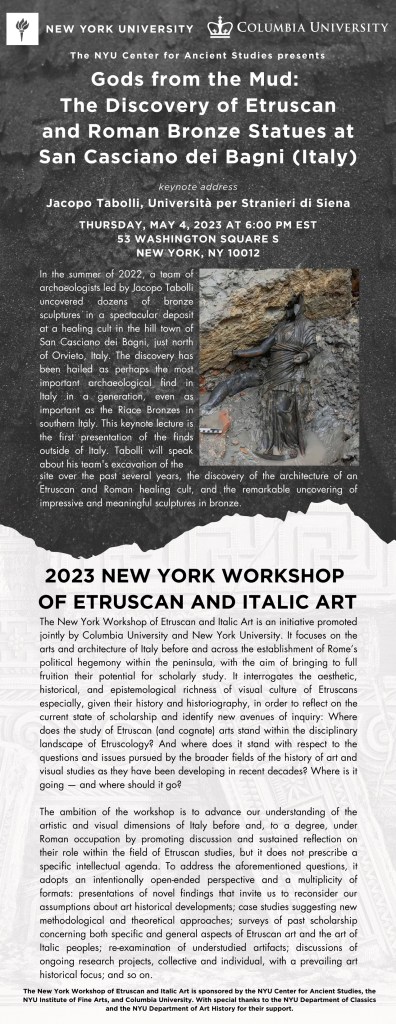
The 2022-2023 Workshop centered on the extraordinary discovery in 2022 of votive offerings from a healing sanctuary at the site of San Casciano dei Bagni, Italy. Presentation of the excavation by Jacopo Tabolli was followed by a roundtable discussion on healing, the body and votive offerings; in the afternoon, with furhter talks on Etruscan mirrors, gems, and sarcophagi. The third day of the converence was a celebration of the life and work of Larissa Bonfante, an inspiration and model for Etruscologists in the United States and in New York especially.
Keynote
Jacopo Tabolli (Università per Stranieri di Siena)
Roundtable
The Thermo-Mineral Sanctuary of Bagno Grande between the Etruscans and the Romans: Water before Context – Context before Artifacts.
Jacopo Tabolli (Università per Stranieri di Siena)
Reflections: Claire Bubb (New York University/ISAW), Mary-Evelyn Farrior (Columbia University), Giovanni Lovisetto (Columbia University), Dan-el Padilla Peralta (Princeton University), Jean McIntosh Turfa (University of Pennsylvania), Ittai Weinryb (Bard Graduate Center)
Panel on Mirrors, Gems and Sarcophagi
Self-Rpresentation on Etruscan Gems?
Nancy Th. De Grummond (Florida State University)
(3-3:30: Coffee Break)
Mirrors and Monumentality: The Etruscans’ Grandiose Tang Mirrors in Context
Alexandra A. Carpino (Northern Arizona University)
The Tetnies Sarcophagi from Vulci and the Etruscan Collection at MFA, Boston
Phoebe Segal (MFA Boston)
2020-2021
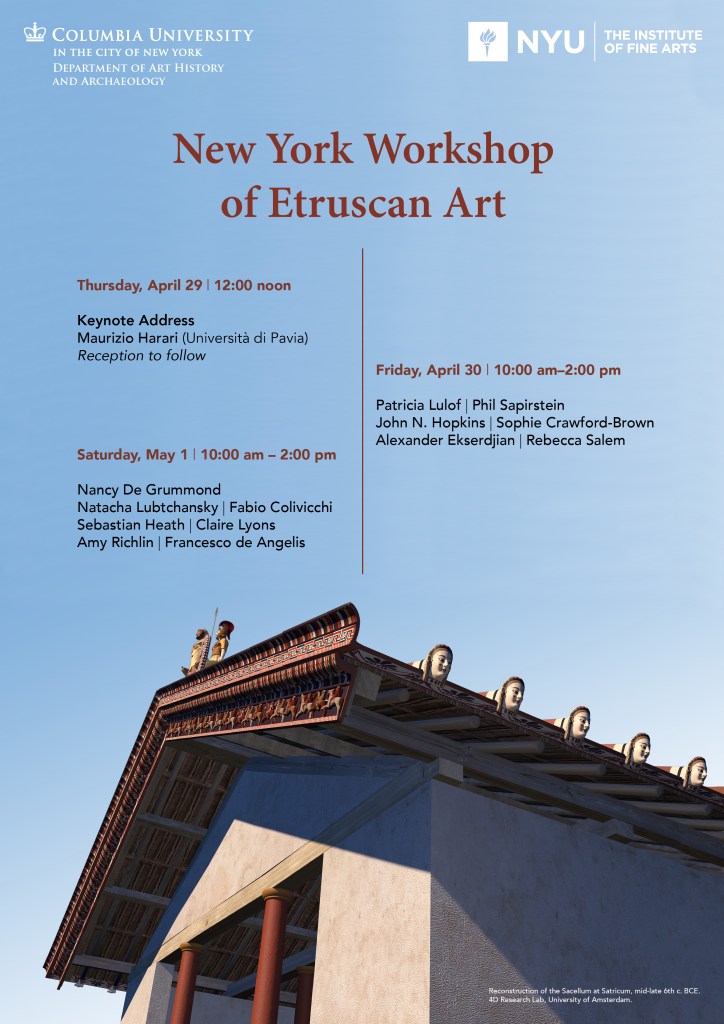
In 2020-2021, the keynote talk investigated the ideological history of the discipline of Etruscology vis-à-vis modern European perceptions of the past. The talk was published in the Journal of Etruscan and Italic Studies in 2021. The workshop focused on discussion of buildings, their roofs and decoration, and the avenues they provide to investigate production processes, networks of interaction and creation, the sacred image, and the porousness of Italic arts; the impact of 3D-modeling and reconstructions on our understanding of Etruscan aesthetics; the presentation of new findings from the Corpus Speculorum Etruscorum and of unpublished bronze figurines of subordinate characters; and the exploration of the relation with comedy of the imagery of Praenestine cistae.
Keynote Talk
“Imagining the Etruscans: Modern European Perceptions of an Ancient Italian Civilization”
Maurizio Harari (Università di Pavia)
Panel on architectural terracottas
“A Caeretan Roof in Satricum: Etruscan Networks South of Rome in the Sixth Century BCE”
Patricia Lulof (Universiteit van Amsterdam)
“The Synthesis of Regional Styles in Early Monumental Greek Architecture at Archaic Corcyra”
Phil Sapirstein (University of Toronto)
Response
John N. Hopkins (New York University)
“The New Ancient: Temple Roofs in the Later Republic”
Sophie Crawford-Brown (Rice University)
“Asia in Etruria? The Talamone Pediment and the Art of Pergamon”
Alexander Ekserdjian (Columbia University)
Response
Rebecca Salem (New York University)
Panel on Mirrors and Digital Projects
“New Insights on Etruscan Mirrors in Baltimore and Washington”
Nancy De Grummond (Florida State University)
10:30 am-12:00 noon
“Orco 4D: From the Museum Back to the Tomb, Via the Archives”
Natacha Lubtchansky (Université de Tours)
“Experiencing the Hypogaeum of Clepsina at Caere. Ancient Perceptions and Modern Speculations”
Fabio Colivicchi (Queen’s University)
Response
Sebastian Heath (New York University)
Panel on images of enslavement and servitude
“Comical Servants and Dozing Africans: Rethinking Images of Servitude at the Etruscan Banquet”
Claire Lyons (J. Paul Getty Museum)
“Slave Cooks as Comic Figures: Resistance, Appropriation, Circulation”
Amy Richlin (University of California, Los Angeles)
Response
Francesco de Angelis (Columbia University)
2018-2019
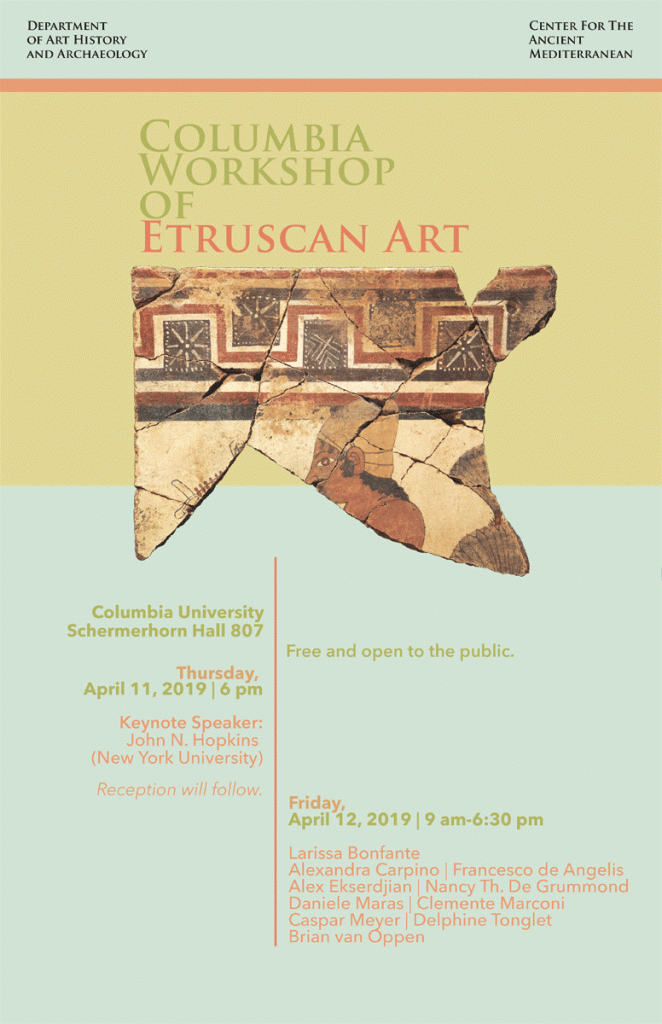
The inaugural workshop examined interactions among the manifold artistic traditions that were at play in the Orientalizing period; addressed the historical implications for ancient painting of the stunning terracotta plaques from Caere, recently retrieved from the illegal art market; explored the heuristic productivity of the notion of entanglement when applied to artistic exchanges as they are made manifest in ceramic typologies; identified past trends and future directions of the study of engraved mirrors; adopted an anthropological and contextualizing approach to understanding the aesthetic impact of the human bodies decorating Etruscan candelabra; and reflected on the relationship between the history of Etruscan art and ancient art more generally. Furthermore, the keynote talk suggested innovative ways of conceptualizing early Roman art through the ideas of folded temporalities and cultural connections.
Keynote Talk
“Folding Time, Folding Culture: The Ficoroni Cista and the Multivalence of Early Roman Art”
John N. Hopkins (New York University)
Panels
“Phoenicians and Phaeacians : The Orientalizing World and the Etruscans”
Larissa Bonfante (New York University, Emerita)
Respondent: Francesco de Angelis (Columbia University)
“Conceptualizing Etruscan Pottery Shapes: Between Ancestral Traditions and Multicultural Entanglement”
Delphine Tonglet (Université Libre de Bruxelles)
Respondent: Caspar Meyer (Bard Graduate Center)
“Back to Cerveteri: Masterpieces of Etruscan Painting on Looted Terracotta Plaques”
Daniele Maras (Soprintendenza ABAP per l’Area Metropolitana di Roma, la Provincia di Viterbo e l’Etruria Meridionale)
Respondent: Clemente Marconi (Institute of Fine Arts, NYU)
“The Mirror of Etruscan Art History”
Nancy Th. De Grummond (Florida State University)
Respondent: Alexandra Carpino (Northern Arizona University)
“Radiant Bodies, Remembered: Etruscan Candelabra at the Tomb”
Brian van Oppen (Columbia University)
Respondent: Alex Ekserdjian (Columbia University)
“Towards an Etruscan History of Art”
Francesco de Angelis (Columbia University)
 Larissa Bonfante Workshop